

Where Do Swedish Meatballs Come From? A Short History
Swedish meatballs with cream sauce are small, allspice-scented and served with mashed potatoes and lingonberries. Here is where the dish is said to come from, how it varies and what to put on the table with it.
Featured Recipe
Swedish Meatballs with Cream Sauce (Köttbullar)
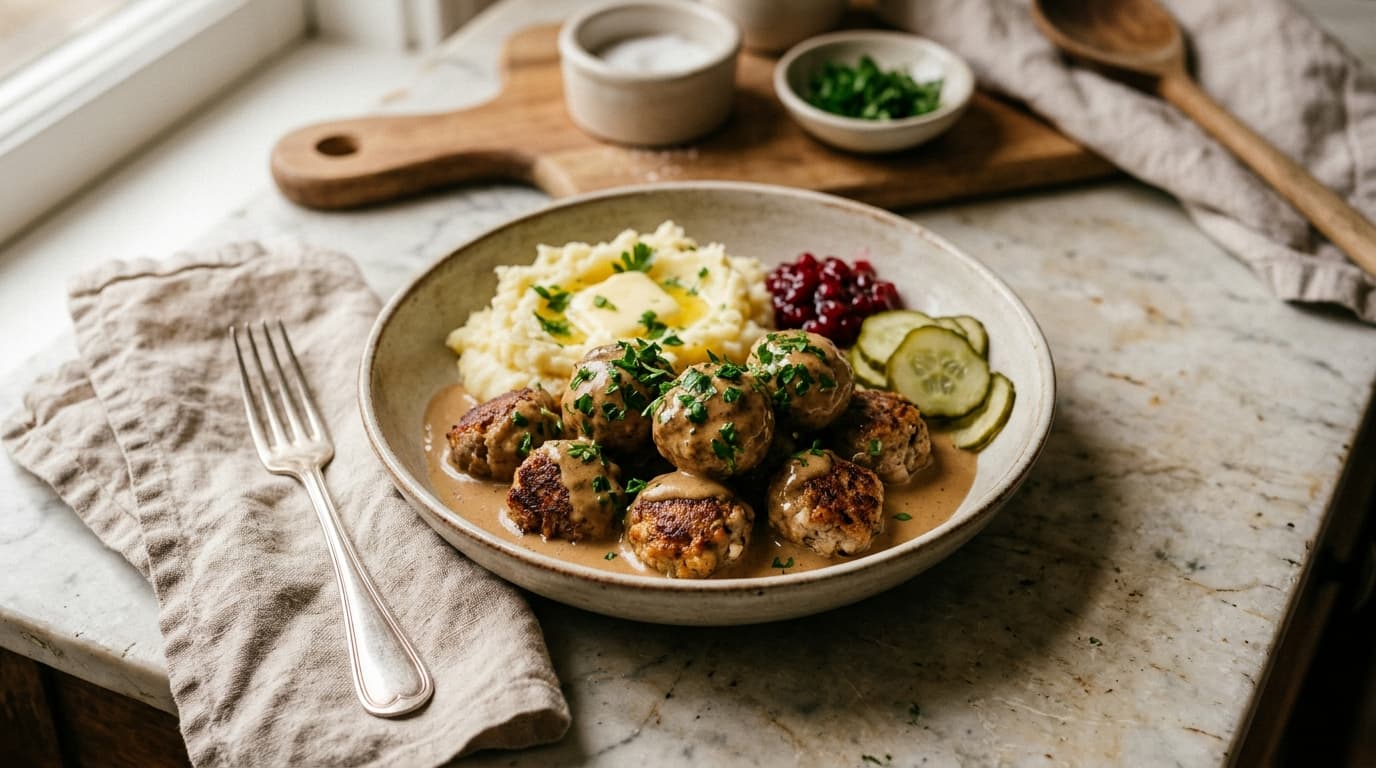
Swedish meatballs with cream sauce are small, tender and gently scented with allspice, set in a silky, lightly browned sauce. A spoonful of tart lingonberries cuts through the richness, and a mound of mashed potatoes catches every last bit of gravy. It is a plate that tastes like a warm kitchen, and it belongs to Swedish, and more broadly European, home cooking.
People love it because nothing about it is difficult to enjoy. The meatballs are soft, the sauce is mellow, and the sweet-tart berries keep each bite from feeling heavy. It is a dish that suits children and grandparents equally, and it holds its own at a holiday table.

Where Swedish meatballs come from
In Sweden they are köttbullar, from kött, meaning meat, and bulle, which roughly means bread roll. The word often stands for the whole plate: meatballs, potatoes, cream sauce and lingonberries. Sweden treats it as a national dish.
The most popular origin story involves King Charles XII (Karl XII). He is said to have encountered spiced meatballs during his years in the Ottoman Empire, in the era of the Great Northern War, and to have brought the idea home. One account puts his safe passage back to Sweden in 1714. Food historian Rachel Laudan is credited with tracing the dish to Ottoman köfte, made from ground lamb and spices, and Swedish tradition itself links köttbullar to Turkish köfte.
That story got a public airing in 2018, when the Swedish government tweeted that meatballs came from Turkey. Historians weighed in on the claim, so it is best treated as a popular account rather than settled fact.
What the written record does support is a date. A recipe for köttbullar appears in Cajsa Warg's 1755 cookbook, Guide to Housekeeping for Young Women, and it is often cited as the first Swedish recipe in print.
How it varies
The traditional plate is quite fixed: meatballs in cream sauce, potatoes and lingonberry compote. The potatoes are usually mashed, though boiled potatoes are also common. Allspice is the signature spice, and families tend to argue over how much to use and what else to add.
Köttbullar also turn up at the smörgåsbord, where they are a fixture. They have a place of honor at Midsummer festivals and at the Christmas smörgåsbord, so the same dish can be a casual supper or a festive one depending on the table around it.
Modern versions bend the formula in familiar directions. Some cooks make the sauce richer or lighter, and low-carb adaptations are now easy to find. Others serve the meatballs on their own as party bites. The plate that most people remember, with cream sauce, mash and berries, is still the benchmark.
When to make Swedish meatballs
This is a natural Sunday dinner. It is unhurried and satisfying, and it feels like a proper meal without needing a showy centerpiece. Make it when you want the table to settle in and linger.
It shines from autumn into winter. On a cool October evening, potatoes, apples, carrots and beets are all at their best in the Northern Hemisphere, and they fit the plate easily. Lingonberries ripen in late summer and autumn, which is part of why the dish feels so right then. It also suits a December gathering, echoing the Christmas smörgåsbord tradition. In June, a Midsummer-style table with new potatoes and fresh dill makes it feel lighter.

What to serve with Swedish meatballs
- Mashed potatoes: the classic partner, soft enough to soak up the cream sauce.
- Lingonberry compote: its tartness balances the richness. Cranberry sauce is a fair stand-in if you cannot find lingonberries.
- Quick-pickled cucumber: a crisp, sharp, cool contrast that wakes up each bite.
- Buttered green beans or peas: a simple green side that does not compete with the sauce.
- A crisp lager or sparkling apple cider: both are bright enough to cut through the cream. A light red such as Pinot Noir also works.
Make it at home
The version we cook on Meez comes from Gustofolio. When you are ready to cook, get the recipe, or cook it step by step in Cook Mode if you would like your hands free while you work.
Questions about Swedish meatballs
Are Swedish meatballs really from Turkey?
Many accounts trace them to Ottoman köfte brought home by King Charles XII, and Sweden's government said as much in a 2018 tweet. Historians have debated the claim, so it is safest to call it the best-known theory rather than proven fact.
What does köttbullar mean?
It combines kött, meaning meat, with bulle, which roughly means bread roll. In everyday use it often refers to the whole plate, with potatoes, cream sauce and lingonberries.
What do you serve with Swedish meatballs?
Traditionally, mashed or boiled potatoes, lingonberry compote and cream sauce. Pickled cucumber and a simple green vegetable round out the plate nicely.
How are Swedish meatballs different from Italian meatballs?
Swedish meatballs are usually small and seasoned with allspice, and they come in a cream sauce with potatoes and lingonberries. Italian-style meatballs are more often served in a tomato sauce, with pasta or bread.
Sources
- Classic Swedish Meatballs (Köttbullar) – The Real Deal Recipe
- Köttbullar: the Swedish national dish | SCANDI
- Uncovering The Surprising History Of Swedish Meatballs And Their Turkish Connection
- Swedish Meatballs: A Deep Dive into Its History and Keto Transformation
Last reviewed November 13, 2026. Written by the Meez editorial team with Meez Magic, from the sources above.
Original Recipe Source
This article is inspired by a recipe from Gustofolio.
Visit the original source for their version of this recipe and more great content.
Related Topics
Enjoyed this article? Share it with fellow food lovers!
Ready to Cook This Recipe?
Experience our immersive Cook Mode with step-by-step visual guidance, voice narration, and built-in timers.