

What Is Cassoulet? History, Variations and What to Serve
Cassoulet is the French bean and meat stew of Languedoc, named for the earthenware dish it is cooked in. Here is where it comes from, how the regions argue over it, and how to build a meal around it.
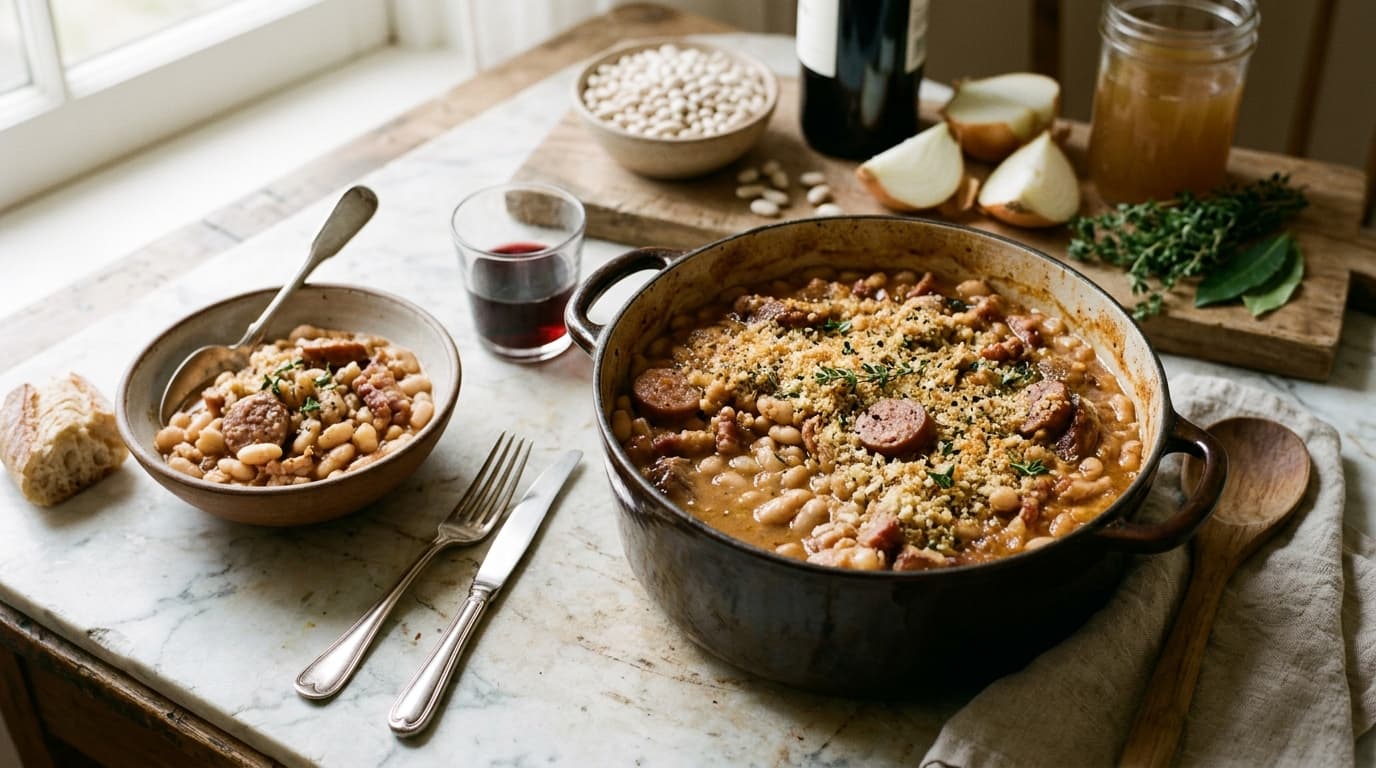
Cassoulet is a French stew of white beans slow-cooked with pork and sausage until the beans turn creamy and the whole pot smells of garlic, herbs and rendered fat. The top is usually left to form a deep golden crust, and a spoon breaks through it into something soft, savory and almost spoonable like a thick soup.
People love it because it is generous and unfussy. It is a rustic dish from southwestern France that asks for patience rather than skill, and it feeds a table well. Few meals are as plainly comforting on a cold evening.

Where cassoulet comes from
Cassoulet belongs to Languedoc, in the south of France. Most accounts place its birth in Castelnaudary, in the Aude department of Occitanie, though Carcassonne and Toulouse have long made their own claims. Its roots are humble. The Carcassonne tourist office describes it as a dish of the people, even a dish for the poor, that chefs later turned into a nationally loved meal.
The name is thought to come from cassole (caçóla in Occitan), the wide, deep, glazed earthenware dish it is cooked and served in. One story credits an Italian potter at Issel, near Castelnaudary, with inventing that dish in the 14th century. The brotherhood that champions the Castelnaudary version, La Grande Confrérie du Cassoulet, says cassoles have been made in Issel since 1377.
A popular legend ties the dish to the siege of Castelnaudary during the Hundred Years' War. The townspeople are said to have pooled whatever food they had into one hearty pot, and the fortified defenders drove off the English. It is a good story, and it is only a legend. Other theories point to Arab influence and trade in southern France, and the sources agree that the real history is tangled. Beans themselves changed along the way: lingot beans grown in the Lauragais are said to have replaced the broad beans originally used.
How cassoulet varies
The best-known way to sort the variations comes from the chef Prosper Montagné, who described a “Trinity”: Castelnaudary as the Father, Carcassonne as the Son and Toulouse as the Holy Spirit. Castelnaudary's version is built on pork, including loin, ham, leg, sausages and fresh rind. Carcassonne and Toulouse shift the meats. Toulouse versions are often described as adding duck or goose confit, but expect local cooks to disagree with any tidy summary.
At home, cooks adjust to what they can find. Good pork sausage stands in for regional links, and some cooks add a layer of breadcrumbs for the crust while others let the beans and fat brown on their own. Purists argue about all of it. The pork and sausage version we cook is a classic, approachable take that keeps the soul of the dish without a long shopping list of specialty cuts.
The version we cook on Meez comes from Analida's Ethnic Spoon.
When to make cassoulet
Cassoulet is built for the cold months. Late autumn through winter is its season, when leeks, cabbage, kale, carrots, parsnips and celery root are at their best in the Northern Hemisphere, and when a oven-warmed kitchen is a pleasure rather than a burden.
- Sunday dinner: it suits a slow afternoon and a full table, and it only gets better when left alone to bubble.
- Cozy comfort: a snowy evening in January is exactly what this dish is for.
- A weekend project: it rewards a cook who wants to spend a Saturday on something worthwhile, with leftovers that taste even better the next day.
It also works for a small gathering where you want to serve one impressive pot instead of juggling courses.

What to serve with cassoulet
The stew is rich, so the best companions are sharp, crisp or simple.
- A bitter green salad with a sharp vinaigrette: frisée, endive or arugula cut through the fat and reset your palate between bites.
- Crusty bread: for the last of the juices, though the beans are filling enough that a little goes a long way.
- A rustic red wine: a Languedoc red from Corbières or Minervois suits the dish and the place it comes from.
- Cornichons and mustard: small, tangy and good at brightening each spoonful.
- A pear or apple tart: a fruit dessert keeps the end of the meal light.
Make it at home
Ready to cook it yourself? Get the recipe for the full ingredient list and method, or cook it step by step in Cook Mode so your hands stay free while the pot does its work.
Questions about cassoulet
What is cassoulet?
It is a French dish of white beans slow-cooked with meats, traditionally pork and sausage, in a deep earthenware pot. The top browns into a crust while the beans underneath stay soft and creamy.
Where does cassoulet come from?
It comes from Languedoc in southwestern France, and most accounts place its origin in Castelnaudary. Carcassonne and Toulouse both claim a version of their own.
Why is it called cassoulet?
The name is thought to come from cassole, the wide, deep glazed earthenware dish used to cook and serve it. The dish is named for the vessel, not for any ingredient.
How is cassoulet different from baked beans?
Cassoulet is built around meat, with pork and sausage cooked together with white beans, and it is savory rather than sweet. Baked beans are typically a sweeter dish where the meat, if any, plays a supporting part.
Sources
- Cassoulet
- Quel Cassoulet! - France Today
- The History and Regional Variations of Cassoulet - Grapes & Grains
- Cassoulet: Savory Taken Seriously
- Le cassoulet : Grand Carcassonne
Last reviewed November 19, 2026. Written by the Meez editorial team with Meez Magic, from the sources above.
Original Recipe Source
This article is inspired by a recipe from Ethnicspoon.
Visit the original source for their version of this recipe and more great content.
Related Topics
Enjoyed this article? Share it with fellow food lovers!
Import a recipe, start cooking
Paste any recipe URL and we'll turn it into a Cook Mode experience with step-by-step visuals, voice narration, and built-in timers.