

History of Beef Bourguignon: Origins of France's Wine Stew
Beef bourguignon is France's most famous red wine stew, with tender beef, bacon, mushrooms and pearl onions in a glossy sauce. Here is where it came from, when it shines and what to put on the table beside it.
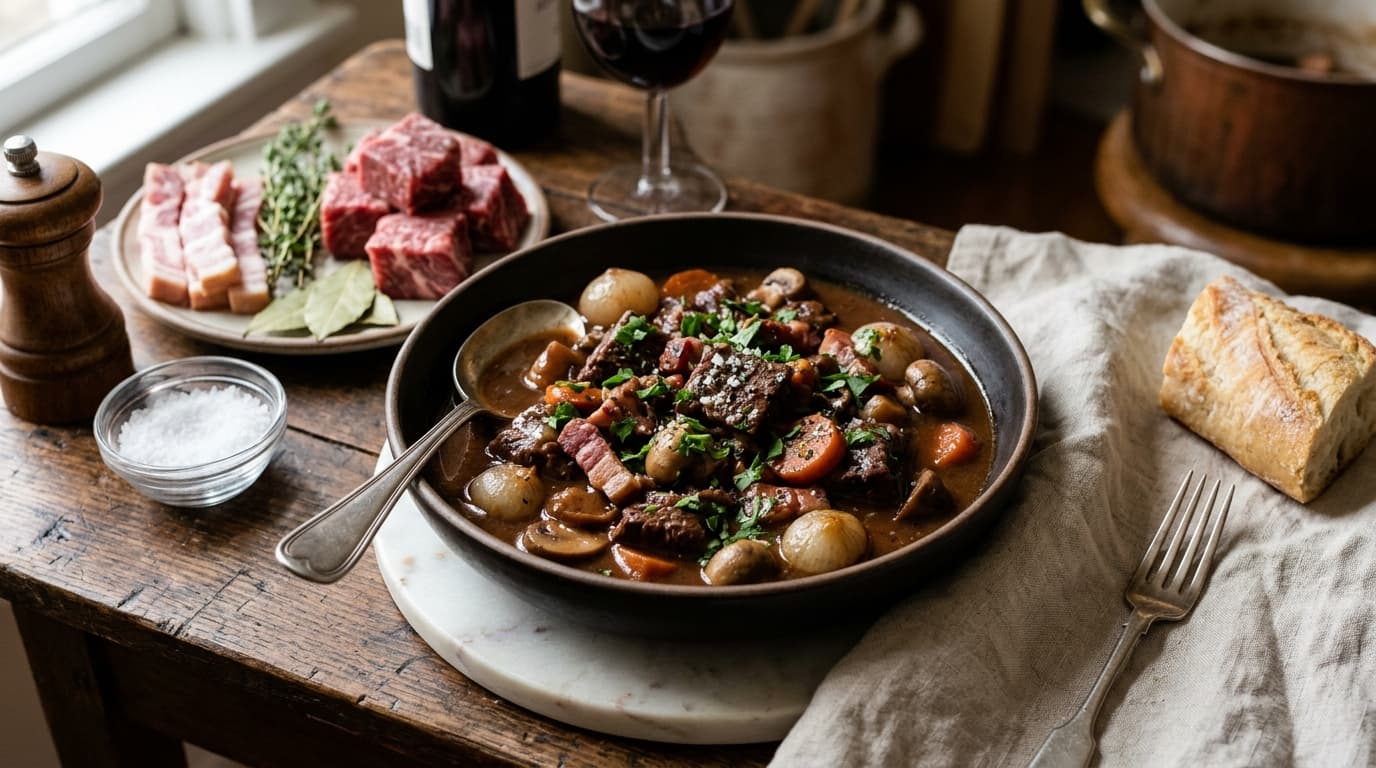
Featured Recipe
Beef Bourguignon
Beef bourguignon is a French stew of beef braised in red wine until the meat gives way under a spoon. The sauce turns deep, glossy and just thick enough to cling, and it is studded with smoky lardons, small whole onions and browned mushrooms. It is rich without being heavy, and savory with a faint winey tang underneath.
People love it because it asks so little at the table and gives so much. It is the kind of dish that makes a quiet evening feel like an occasion, and it tastes even better when it has had a little time to settle. One pot, a long slow braise, and the kitchen smells wonderful by the time anyone sits down.

Where beef bourguignon comes from
The name points to Burgundy, and most accounts treat the dish as a humble one. Gambero Rosso describes it as a peasants' dish from the Burgundy countryside, braised in the local wine. Another source pairs it with two of the region's best-known products, red wine and Charolais beef. The idea of slow-cooking tough meat until tender is often traced back to the Middle Ages.
The paper trail is thinner and the sources do not agree. Tasting History dates a recipe to 1885 and says the early version was a sauce for leftover stewed beef, which only later became the stew we know. Gambero Rosso says the first written traces appeared in 1903, thanks to the chef Auguste Escoffier. Wikipedia notes that since the mid-nineteenth century, “bourguignon” has been a culinary term for various dishes, not just this one.
What the sources do share is Escoffier's role. He is credited with bringing the dish to high society in Paris and London, and luxury hotels like the Ritz helped make it fashionable. It later turned up in fine dining in New York too. Julia Child is credited with popularizing it further, and it is now a national specialty that appears in bistros and home kitchens alike.
How it varies
The classic build is fairly settled: beef, red wine (often a red Burgundy), beef stock, lardons, onions, a bouquet garni, pearl onions and mushrooms. Within that frame, cooks make their own choices. They differ on the cut and size of the beef, on whether the meat is marinated overnight in the wine, and on whether the onions and mushrooms are cooked separately and added at the end or simmered in the pot throughout.
Modern versions bend the method more than the flavor. Some cooks use a slow cooker or a pressure cooker, and some add carrots to the braise for sweetness. Others swap in a different red wine or finish the sauce with a spoonful of tomato paste or a splash of brandy. Traditional cooks would say the heart of the dish is good wine, patient browning and unhurried cooking, and every version above keeps those.
It is also worth separating it from its cousin coq au vin. Both are French braises in red wine, but coq au vin uses chicken. Beef bourguignon is the deeper, more robust of the two.
When to make it
This is a Sunday dinner dish through and through. One French source notes it is often cooked on Sundays, simmered gently while the rest of the day carries on around it. It is also a good weekend project. You can brown the meat, build the sauce and let the pot do its work while you do something else, and the reward comes at the table.
It shines from late autumn through winter. A November Sunday suits it, as does a cold January weekend when you want the house warm and the oven busy. That is also when the produce that belongs beside it is at its best in the Northern Hemisphere: mushrooms, carrots, parsnips, celery root, potatoes, winter squash and pears for dessert.

What to serve with beef bourguignon
The sauce is the star, so the best sides are the ones that catch it.
- Buttery egg noodles or mashed potatoes. Both are soft and mild, and they soak up the wine sauce. Potatoes are the more traditional pairing, noodles the quicker one.
- A crusty baguette. Every plate needs something for mopping up what the spoon leaves behind.
- A sharp green salad. Bitter leaves and a mustardy vinaigrette cut through the richness and reset your palate between bites.
- Simple green beans or glazed carrots. They bring color and a little freshness to a plate that is otherwise deep brown.
- A glass of red Burgundy. Pinot noir echoes the wine in the pot. If you are cooking with a bottle, pour the same one at the table.
Make it at home
The version we cook on Meez comes from Kitchn. Get the recipe for the full ingredient list and method, or cook it step by step in Cook Mode so your hands stay free at the stove.
Questions about beef bourguignon
What is beef bourguignon?
It is a French stew of beef braised in red wine, usually with lardons, pearl onions, mushrooms and a bouquet garni. The result is tender meat in a rich, velvety sauce.
Where does beef bourguignon come from?
It is named for Burgundy and most accounts trace it to the region's countryside, with medieval roots as a humble braise. The earliest written versions date to the late nineteenth or early twentieth century, depending on the source.
Who made beef bourguignon famous?
Auguste Escoffier is credited with bringing it to fine dining in Paris and London. Julia Child is widely credited with popularizing it later.
How is beef bourguignon different from beef stew?
Beef bourguignon is defined by its red wine base, along with lardons, small onions and mushrooms. A general beef stew might use stock, water or beer, and often includes more vegetables cooked right in the pot.
Sources
- Beef bourguignon
- French boeuf bourguignon: history and origins - Gambero Rosso International
- Beef Bourguignon — Tasting History
- Beef Bourguignon
- Traditional Beef Bourguignon Recipe
Last reviewed November 19, 2026. Written by the Meez editorial team with Meez Magic, from the sources above.
Original Recipe Source
This article is inspired by a recipe from The Kitchn.
Visit the original source for their version of this recipe and more great content.
Related Topics
Enjoyed this article? Share it with fellow food lovers!
Ready to Cook This Recipe?
Experience our immersive Cook Mode with step-by-step visual guidance, voice narration, and built-in timers.